
What Indiana's 2026 Property Tax Changes Actually Mean for Monroe County Homeowners
Indiana passed one of the biggest property tax overhauls in decades last year. Senate Enrolled Act 1 was signed into law in April 2025, and for most Monroe County homeowners, the changes showed up for the first time on 2026 tax bills. The state promised relief. Some people got it. Some people didn't, and plenty of homeowners across Indiana are genuinely confused about why their bill didn't drop the way they expected. This piece is going to walk through exactly how the new law works, what changed, and what you can do about it if you think something is off. And at the end, I'm going to show you a side-by-side comparison of two identical houses in Monroe County, one with the homestead exemptions filed correctly and one without, so you can see in real numbers what's actually at stake.
I'm not going to position myself as a tax attorney here, because I'm not one. I'm a real estate broker with 20 years in this market, and I watch what happens to buyers and sellers when they don't understand their property tax exposure before they close. That's my lane, and that's where this is useful. For your specific situation, the Monroe County Auditor's office and a local accountant are the right people to call.
First: Why Your Bill Might Not Have Dropped
The state projected that about two-thirds of Indiana homeowners would see a lower 2026 tax bill compared to 2025. That's a lot of people. But it's not everyone, and county officials across Indiana have been fielding calls from frustrated homeowners who expected a reduction and didn't see one. There are a few reasons this happens.
The biggest one is assessed value. Indiana assesses property at 100% of market value, and values have risen substantially in Monroe County over the past several years. If your assessed value went up enough in 2025, the new credits and deductions may have offset the increase without actually lowering your bill from last year. The math still worked in your favor compared to what it would have been under the old law, but your bill compared to last year's bill may look flat or even slightly higher.
The second reason is homestead filing status. The 10% homestead credit, which is the most visible piece of SEA 1 for individual homeowners, only applies if your homestead deduction is on file. If you bought a home in 2025, refinanced, or changed ownership in any way, there's a chance your homestead deduction didn't transfer correctly. The credit doesn't appear automatically for new owners the way it does for established homesteads. You have to file.
The third reason is that property tax rates in Indiana are set at the district level, not the county level. Your rate depends on which taxing district your address falls in, and districts vary across Monroe County based on which schools, libraries, fire departments, and special levies apply to your specific parcel. Two houses on different streets in Bloomington can carry different gross tax rates.
What SEA 1 Actually Changed for 2026
Here's a plain-language summary of the key pieces that are now in effect for 2026 bills, sourced from the Indiana Department of Local Government Finance and the state legislature's own documentation.
The 10% Homestead Credit (New)
Every homestead in Indiana now receives a credit equal to 10% of the property tax bill, up to a maximum of $300 per year. This credit is applied automatically if your homestead deduction is already on file. You do not need to apply separately. The credit reduces your bill after all deductions have already been calculated, meaning it comes off the final number, not the assessed value. If your bill is at the 1% constitutional cap, this credit still applies and will reduce your bill below the cap. That's new. Under prior law, seniors and veterans at the cap couldn't get further relief. Now they can.
The Standard Homestead Deduction (Changing)
This is where the long-term math starts to shift. The standard homestead deduction is being phased down. For the 2026 tax year, it's the lesser of 60% of your gross assessed value or $40,000. Under prior law it was $45,000. It will continue to decrease through 2030, when it is scheduled to be eliminated entirely.
To offset this, the supplemental homestead deduction is increasing over the same period. For 2026, the supplemental deduction is 40% of the assessed value remaining after the standard deduction is applied. The combined effect is that more of your home's value is being protected through the supplemental percentage and the new credit, while the flat standard deduction shrinks. For higher-value homes, the shift often works out to roughly the same or slightly better protection. For lower-value homes, the picture can be tighter and it's worth checking your specific numbers.
The Senior Credit (Restructured)
The Over-65 Deduction has been converted to an Over-65 Credit, worth up to $150 per year. The income limits were also expanded: up to $60,000 for single filers and $70,000 for joint filers. Converting from a deduction to a credit means the relief is more consistent across home values and applies even to homeowners at the 1% cap, which was not true before. If you or a family member buying a home in Monroe County qualifies, this is worth verifying with the Monroe County Auditor.
Non-Homestead Residential (New Deduction Starting 2026)
If you own a non-homestead residential property, such as a rental or a second home, there's a new deduction starting in 2026 as well. It begins at roughly 6% to 7% of assessed value and is scheduled to increase incrementally through 2031, when it reaches 33.3%. This is relevant for investors and for parents who own property in Bloomington for a student but don't qualify for the homestead deduction because it's not their primary residence.
Speaking of the student property situation, I covered that in detail in my earlier piece on hidden costs of buying in Bloomington. The tax treatment of investment or non-owner-occupied property is a meaningful cost line that changes what these purchases actually pencil out to.
The Side-by-Side: Two Identical Monroe County Homes, One Right and One Wrong
Here's where things get concrete. Take two hypothetical homeowners. Same county, same approximate home value. One has the homestead exemptions filed correctly. The other bought recently and the paperwork didn't get done. Let's walk through the math.
I'm using a home assessed at $325,000, which is close to the April 2026 Monroe County median sale price based on Indiana Regional MLS data, and applying the Monroe County median effective tax rate of 0.97%, sourced from Ownwell's April 2026 county data. This is a reasonable approximation for illustration purposes. Your actual rate will vary depending on your specific taxing district within Monroe County, because districts include different combinations of school, library, township, and city levies. The Monroe County Auditor's office can tell you the exact certified gross rate for your parcel.
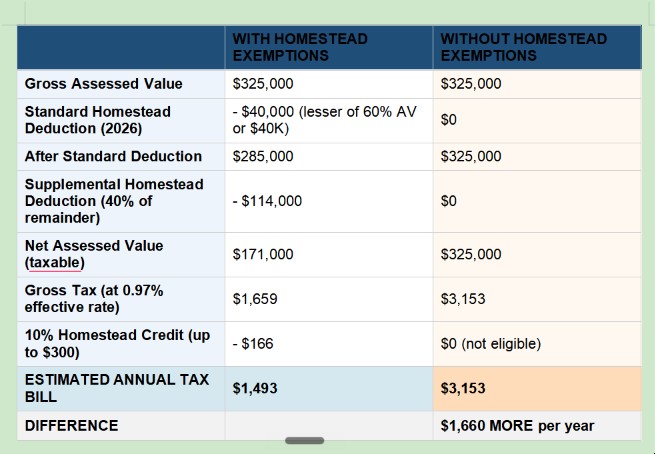
That $1,660 annual difference is $138 per month, which is real money. And that's at a $325,000 price point. At $400,000 or above, the gap is wider. The homestead deductions alone shield more than $154,000 of assessed value from taxation. The 10% credit on top of that is additional savings. None of this happens automatically for a buyer who fails to file.
The 1% constitutional cap also factors into some scenarios. Indiana's constitution limits property taxes on a primary residence to 1% of gross assessed value. On a $325,000 home, that's a $3,250 maximum. Without exemptions, a homeowner in a higher-rate taxing district within Monroe County might find themselves at or near that cap. With exemptions, the taxable base is reduced far enough that the 1% cap becomes less relevant. The credit still applies even when the cap is reached, which is one of the meaningful changes under SEA 1.
The June 15 Assessment Appeal Deadline
Here's a time-sensitive item, and I'm including it because this article is going out in mid-June 2026. If you received a Form 11 notice of assessment and you believe the assessed value on your property is incorrect, the deadline to file a Form 130 appeal with the Monroe County Assessor is June 15, 2026. That's extremely close. If you've been sitting on a Form 11 that looked wrong and haven't acted on it yet, call the Monroe County Assessor at (812) 349-2842 today.
An appeal on your assessed value affects your 2026 taxes payable in 2027, not the current bill. But getting the assessed value corrected now sets the right baseline going forward, especially as the deduction structure continues to shift over the next several years under SEA 1.
What This Means If You're Buying or Selling in Monroe County
If you're buying a home in Monroe County this year, property tax needs to be on your checklist before you close, not after. The exemptions don't transfer automatically. The homestead deduction has to be filed for your new address with the Monroe County Auditor. You have until January 15 after the year you purchase to file for that tax year, but the sooner it's done the better.
If you're selling, buyers are going to look at the current tax bill as a proxy for what they'll pay. That's only accurate if the homestead exemption will transfer or be refiled. A buyer who's coming in from Indianapolis or from out of state may not know to ask. Part of my job as a listing agent is to make sure that conversation happens so there are no surprises at the closing table or the following spring when the first bill arrives. I covered some of the other numbers that catch buyers off guard in my piece on Indiana property tax changes for 2026.
The broader cost-of-living question, including how property tax in Monroe County stacks up against what people are coming from, comes up constantly in my relocation conversations. I put together a full comparison in my earlier Bloomington vs. Indianapolis cost of living piece for anyone thinking through that calculation.
What to Do Right Now
If any of the following applies to you, it's worth a call to the Monroe County Auditor at (812) 349-2510 or the Monroe County Assessor at (812) 349-2842:
•You bought a home in Monroe County in 2024 or 2025 and haven't filed your homestead deduction for the new address
•Your 2026 tax bill didn't change much from 2025 and you're not sure why
•You received a Form 11 assessment notice and the assessed value looks higher than what you paid or what comparable homes are selling for
•You're 65 or older and haven't checked whether you now qualify for the expanded Over-65 Credit under the new income thresholds
•You own a rental or investment property in Monroe County and want to understand what the new non-homestead deduction means for your specific situation
I'm not the right person to tell you what you owe or how to appeal. That's what the county offices are there for, and they're generally responsive. What I can do is walk you through what these numbers mean in the context of a purchase or a sale, and make sure property tax is part of the conversation before you commit to anything.
If you have questions about buying or selling in Bloomington, Bedford, or the surrounding communities, reach out.
Lesa Miller, Broker | REALTOR®
Lesa Miller Real Estate, RE/MAX Acclaimed Properties
Serving Bloomington, Bedford and the Surrounding Indiana Communities
(812) 360-3863 | LesaMillerRealEstate.com