What Does the Cottage Grove Conservation District Mean for Bloomington Property Owners?
Bloomington has a new conservation district, and if you own property in central Bloomington or you are shopping there, it is worth understanding what changed. In May 2026, the Bloomington City Council voted 7-1 to designate 120 properties in central Bloomington as the Cottage Grove Conservation District, a decision reported by Indiana Public Media and formalized through Ordinance 2026-07 in the Bloomington Municipal Code. I have been helping buyers and sellers in this market for over two decades, and the questions started coming in almost immediately. Most of them boil down to the same thing. What can I still do with my property, and what now requires permission?
What Is a Conservation District in Bloomington?
A conservation district is the step below a full historic district. According to the City of Bloomington, it is intended to slow radical change in a neighborhood by reviewing only major events. If you want to demolish a building, move one, or construct a new principal or accessory building inside the district, you now need a Certificate of Appropriateness from the Bloomington Historic Preservation Commission. By law, that review can take no more than 30 days after a complete application is received.
That is the full list of what triggers review. Paint color, window replacement, porch enclosures, additions, and routine upkeep require no approval at all. The city does note that a major alteration may draw review if it would destroy or obscure a large amount of original historic material, and the historic preservation program manager is the person to check with in that situation. For the everyday work of owning an older home, nothing changes.
Why Cottage Grove?
This part of central Bloomington holds some of the oldest housing stock in Monroe County. A section of the neighborhood was platted as early as 1853, several of the county's earliest house forms still stand there, and the area includes the only brick Queen Anne structure remaining in Bloomington, according to the city's neighborhood history. The area is zoned residential multi-family, which permits denser and taller construction, and it has drawn a steady stream of demolition permit requests in recent years, as The B Square Bulletin reported during the proposal process. Residents who supported the designation told the council they worried the neighborhood's older homes would be torn down and replaced with larger apartment complexes.
The council vote was not unanimous. The lone no vote argued that added review raises costs for owners and renters and slows the supply of housing. Reasonable people land on different sides of that debate. What matters for you as an owner or a buyer is how the rules work now that they are in place.
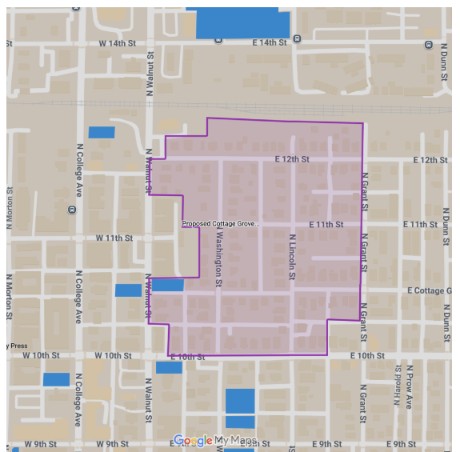
One practical note. The district sits roughly between East 10th and East 12th Streets, from North Walnut Street east to North Grant Street, and the city's Historic Preservation program maintains the official parcel-level map of the 120 included properties. If you own in this part of central Bloomington and are not certain whether your parcel is included, that office is the place to confirm before you make any plans that assume one answer or the other.
The 3-Year Question Every Owner Should Watch
Conservation districts in Bloomington do not stay conservation districts by default. After 3 years, the district is set to become a full historic district unless a majority of property owners inside it object in writing. A full historic district reviews all exterior changes, not just demolition and new construction, and that is a meaningful difference in day-to-day ownership. The Cottage Grove designation happened in May 2026, which puts that conversion question on the calendar for 2029. If you own inside the district, mark that date, because the owners themselves decide whether the stricter rules arrive.
What Does This Mean If You Are Buying in Central Bloomington?
First, confirm whether a property sits inside the district before you write an offer. Second, think about your plans. If you intend to live in the home and maintain it, the district will barely touch your ownership experience. If your plans involve tearing down, building new, or a major alteration to original historic material, you will be working with the Historic Preservation Commission, and you should build that review into your timeline. Third, factor in the 2029 question. A buyer with a 10-year horizon should know the rules could tighten 3 years in. Central Bloomington remains one of the most sought-after parts of this market, and homes close to the courthouse square carry a premium, something I covered in detail in my piece on living near downtown Bloomington.
Neighborhoods with distinct older housing stock, like McDoel Gardens, have held their appeal in large part because the character that draws people in has stayed intact. Preservation rules are one way a city protects that. New construction is the other side of the same conversation, and Bloomington is running that experiment too with Hopewell South, the 24-acre development underway on the former hospital site. A healthy market has room for both.
What Does This Mean If You Own or Plan to Sell in the District?
For most sellers, the designation is a neutral-to-positive fact. Buyers drawn to older homes often read conservation status as reassurance that the block will look recognizable in 20 years. For a small set of properties, mostly those whose highest value was as a teardown or redevelopment site, the designation narrows the likely buyer pool. If you own one of those, the honest move is to price and market with that reality in mind rather than hoping a developer pays land value for a lot they can no longer clear without review.
If you have legal questions about what the ordinance permits on a specific parcel, the city's Historic Preservation program and Ordinance 2026-07 are the right sources, and a local attorney can interpret the fine points. What I can help with is the real estate side. What the designation does to value, marketability, and strategy for your specific property and your specific plans.
If you own in the new district, are weighing a purchase in central Bloomington, or want a straight read on what this means for your property, call or text me at (812) 360-3863 or visit LesaMillerRealEstate.com. Calm, experienced guidance from the first conversation to closing.
Lesa Miller, Broker | REALTOR®
Lesa Miller Real Estate | RE/MAX Acclaimed Properties
Serving Bloomington, Bedford and the Surrounding Indiana Communities
(812) 360-3863 | [email protected]
LesaMillerRealEstate.com