Bloomington vs. Fishers, Indiana: What the Move Actually Costs You
People ask me this more than you'd think. Someone's spouse gets a new job in Indianapolis. Or a Cook Medical career leads to an opportunity with another company in Hamilton County. Or a family has been in Bloomington for 20 years and the kids are grown and they're ready for something different. The question is always some version of the same thing: is Fishers worth it?
I've been selling real estate in Bloomington for over 20 years. I don't sell in Fishers, and I'll tell you upfront that when my clients need help up there, I connect them with someone I trust. What I can do is give you an honest side-by-side of what the move actually means in dollars, lifestyle, and trade-offs, because most of the comparisons out there read like a tourism brochure for both cities and don't tell you much.
So here's the real version.
The Price Gap Is Real, and It's Not Small
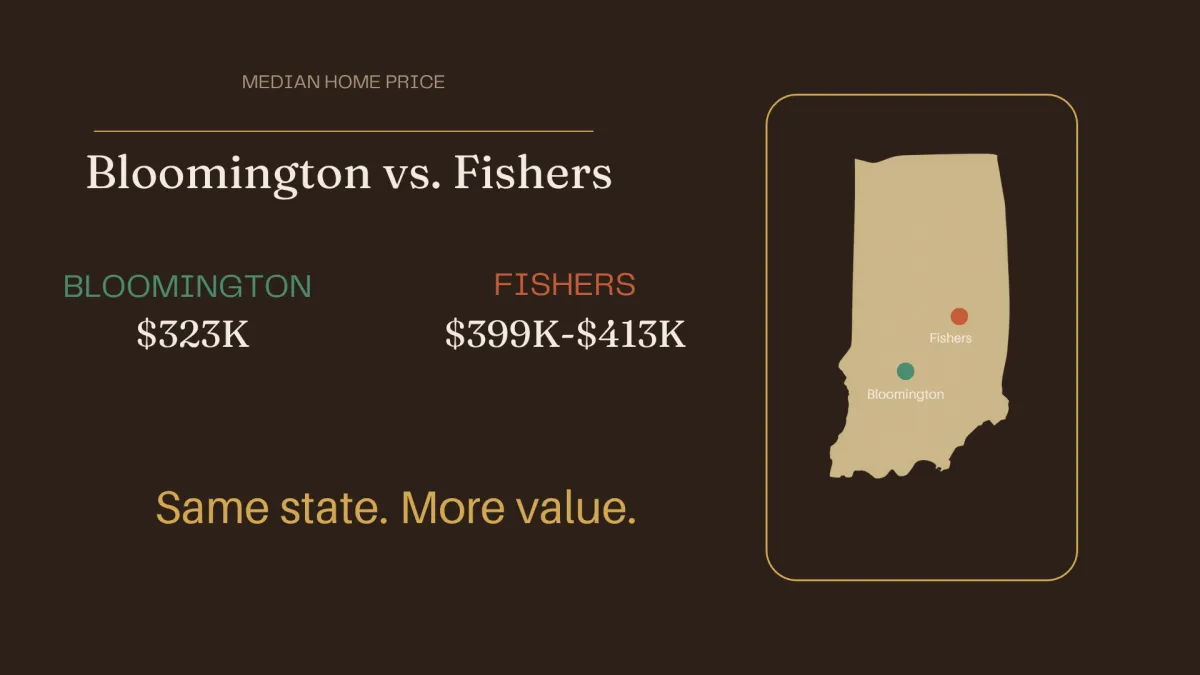
In Monroe County, the median sale price as of the most recent Indiana Regional MLS data sits at $323,698, down about 10% year over year as the market recalibrates from the post-pandemic run-up. Inventory has increased, days on market have tightened to around 28, and the sale-to-list ratio is running at 95.5%. Well-priced homes are still moving. The market has softened, but it hasn't broken.
In Fishers, you're looking at a median sale price in the $399,000 to $413,000 range depending on the month, per Redfin MLS data. That's a price premium of roughly $75,000 to $90,000 over Bloomington on a median-to-median comparison. And that gap doesn't shrink much when you look at comparable square footage, because Fishers homes tend to run newer construction on smaller lots.
That price difference matters more than it looks on paper. At today's rates, a $90,000 increase in purchase price adds somewhere around $550 to $600 per month to a 30-year mortgage payment at 7%. Over five years, you're talking about $33,000 to $36,000 in additional principal and interest before you've factored in anything else.
Property Taxes: This One Cuts Both Ways
Both cities are subject to Indiana's statewide property tax framework under Senate Enrolled Act 1, signed in April 2025, which phases out the standard homestead deduction through 2031 while introducing a new 10% homestead credit up to $300 and expanding the supplemental deduction. The framework applies statewide.
Where things diverge is at the local rate level. Monroe County's local income tax (LIT) runs at 1.05%. Hamilton County, where Fishers sits, has an effective property tax rate around 0.89% to 1.10% depending on the taxing district, with a median annual tax bill around $3,892 according to SmartAsset. Monroe County homeowners on a $323,000 home are generally paying less in total property tax than Hamilton County homeowners on a $410,000 home, for the simple reason that assessed values are substantially higher in Hamilton County.
Worth noting: Fishers' current nominal tax rate sits at 2.2011% under the 3% constitutional cap, per Hamilton County records. Monroe County runs lower. For a direct comparison on your specific situation, talk to a local accountant in whichever county you're considering, or contact the respective county auditor's office. The numbers shift based on your specific property, district, and which deductions you qualify for.
What Your Dollar Buys in Each Market
This is where the conversation gets more interesting than the headline numbers suggest.
In Bloomington, $325,000 to $375,000 gets you into established neighborhoods with mature trees, limestone architectural details that you don't find in newer suburbs, and proximity to a genuinely walkable downtown with independent restaurants, live music, world-class performing arts through Indiana University, and a farmers market at Showers Common every Saturday from April through October. The Buskirk-Chumley Theater, the Monroe County History Center, Switchyard Park with its Friday food truck scene, the B-Line Trail running through the heart of the city. These aren't manufactured amenities. They're things that grew organically over decades.
In Fishers, that same $400,000 price point gets you newer construction, typically in a planned development, with the trade-off being less architectural character but more square footage per dollar in some cases. The Nickel Plate District has built a genuine downtown core over the past several years, with restaurants, breweries, a farmers market running Saturdays May through September with over 80 vendors, and the Nickel Plate Trail for biking and running. It's a real place now, not just an interchange with a subdivision behind it. Fishers has worked hard at this and it shows.
The honest difference is that Bloomington's character accumulated over more than 150 years and IU's cultural calendar adds a dimension that suburbs simply can't replicate. Fishers is building something newer and cleaner. Which one fits your life depends entirely on what you're after.
The Commute Math
Fishers sits about 25 miles north of downtown Indianapolis, with an average commute of roughly 24 minutes per U.S. News data. That assumes you're working somewhere in the Indianapolis metro, which is the whole point of being in Fishers for most people. The I-69 corridor and SR 37 are your main arteries, and like any major suburban corridor, they have their moments during peak hours.
Bloomington to Indianapolis is about 50 miles, roughly 50 to 55 minutes in normal traffic, longer during IU events. If your job moved to the Indianapolis metro and you're thinking about whether to stay in Bloomington and commute, that math usually doesn't work for daily drivers. If you're fully remote or your office is in Bloomington, it's a non-issue.
What people don't always factor in: Fishers is almost entirely car-dependent. Zero percent of commuters use public transit there. If you have two working adults with different work locations, you're budgeting for two-car transportation costs at the higher Hamilton County cost-of-living level.
The Income Picture
Median household income in Fishers runs around $136,502 per U.S. News data. That's a high-income suburb, and it affects everything from the local tax base to the cost of services to what your neighbors are doing on weekends. It also reflects who is moving there, which skews heavily toward dual-income professional households with children.
Bloomington's income profile is more varied, reflecting the mix of university employees, medical and research professionals, skilled tradespeople, and longtime residents. The cost-of-living gap between the two cities is real, and Fishers residents generally earn more to support it. If your income is staying constant and you're moving from Bloomington to Fishers, you're taking a real cost-of-living step up.
Who Actually Makes This Move
Based on 20-plus years of conversations with buyers and sellers, the people who make this move successfully tend to fall into a few categories.
The career-driven relocator whose employer is in the Indianapolis metro. If the job is in Carmel, Fishers, or downtown Indianapolis, the move makes sense and Fishers is a logical landing spot. The schools draw families with children, and Hamilton County's Hamiltion Southeastern or Fishers High School are the destination for a lot of those households.
The empty nester going the other direction, from Fishers to Bloomington, is also a real pattern. Lower prices, paid-off mortgage potential on a downsize, IU's arts and lecture calendar, a slower pace. I see this more than people expect.
The person who leaves Bloomington and regrets the cultural trade-off is also a real category. The Nickel Plate District is good. It's not the same as a city that has been building its arts and food identity since 1820. That's not a criticism of Fishers, it's just a factual observation about depth.
The Bottom Line
Fishers is a genuinely well-run city with strong infrastructure, a growing downtown, and housing that draws buyers for real reasons. The price premium is real, the property tax load at higher assessed values is real, and the lifestyle trade-off is something only you can weigh.
Bloomington has softened on price, inspections and negotiations have gotten meaningfully tougher even as prices have adjusted, and the market is in a recalibration that I'd describe as healthy rather than alarming. For buyers who've been waiting for prices to come down, this is a more accessible window than we've had in several years.
If you're trying to figure out which market makes sense for your situation, I'm happy to talk through it. Give me a call at (812) 360-3863 or visit LesaMillerRealEstate.com. If Fishers is where you're headed, I can connect you with the right person there. If Bloomington is still in the picture, that's my market and I know it well.
Related reading: What to Expect in the Bloomington Real Estate Market This Summer | Indiana 2026 Property Tax Changes: What Bloomington Homeowners Need to Know | Bloomington vs. Indianapolis Cost of Living
Lesa Miller, Broker | REALTOR®
Lesa Miller Real Estate, RE/MAX Acclaimed Properties
Serving Bloomington, Bedford and the Surrounding Indiana Communities
(812) 360-3863 | LesaMillerRealEstate.com