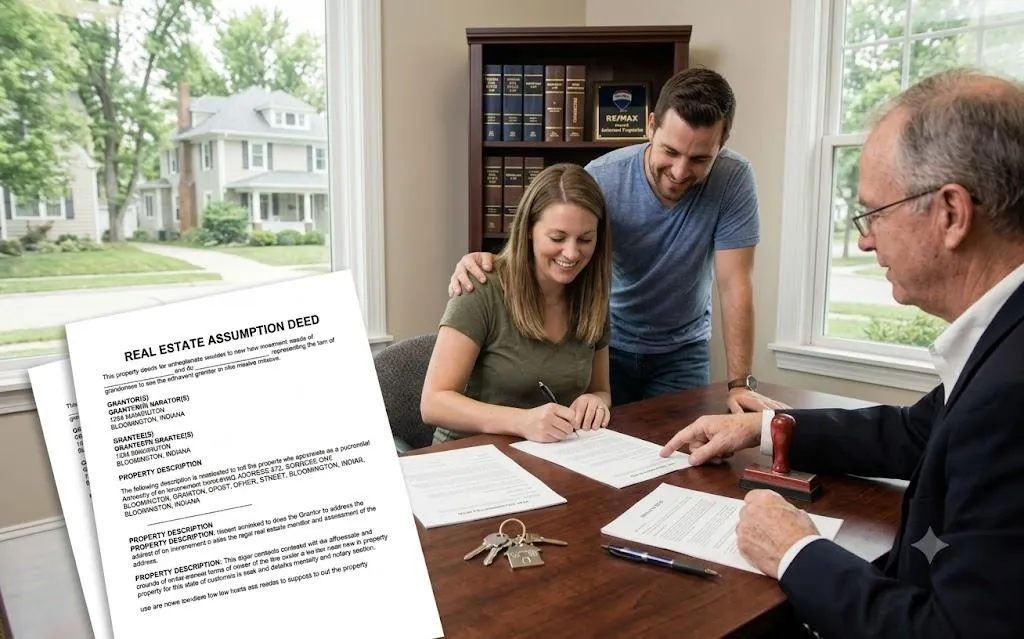
What Is a Real Estate Assumption Deed? What Bloomington and Bedford Buyers and Sellers Should Know
I get a version of this question more often than people expect. Someone is reading through a title search or an older recorded deed and runs into a phrase that stops them: assumption deed. They want to know what it means, whether it still applies today, and whether assuming someone else’s mortgage is a real option in this market. Quick note before we get into it. I am a real estate broker and nothing here is legal advice. A transaction involving a loan assumption needs a real estate attorney and your lender’s underwriting team involved directly, not just me. What I can do is walk through what the term means, which loans qualify, and why this conversation matters more in 2026 than it did a few years ago.
What Is an Assumption Deed, Exactly?
A loan assumption happens when a buyer takes over the seller’s existing mortgage instead of getting a brand new one. Same balance, same interest rate, same remaining term, just a new name on the payments. An assumption deed is the document some states use to spell out, in writing, that the buyer is agreeing to take on responsibility for that debt as part of the property transfer. The term shows up most often in Texas, where it gets paired with a separate document called a deed of trust to secure assumption that protects the seller’s interest if the buyer later stops paying.
Indiana handles the same underlying concept differently. You are less likely to find a standalone document labeled assumption deed recorded at the county recorder’s office here. Instead, the lender’s formal assumption package and the standard warranty deed transferring title do the work together. If you came across the term on an older Indiana deed, that is a good reason to have a real estate attorney pull the full document and confirm exactly what was agreed to, and whether anyone, including a prior seller, still has exposure on that loan today.
Which Loans Can Be Assumed?
This is where most people get tripped up, and it is worth being precise about it. Mortgage assumption is technically possible on most loans, but lenders can block it using a due-on-sale clause written into the mortgage contract. In practice, three loan types are routinely assumable: FHA, VA, and USDA. FHA-insured loans, along with VA loans originated after March 1, 1988, are assumable to a creditworthy buyer because those programs were never built with a due-on-sale clause in the first place. USDA loans work the same way, with their own approval process and underwriting standards.
Conventional loans are a different story, and conventional financing is what most Bloomington and Bedford buyers use. Most conventional mortgages, including anything sold to Fannie Mae or Freddie Mac, include a due-on-sale clause that requires the loan to be paid off in full when the property changes hands. That clause has been enforceable since 1982 under the federal Garn-St Germain Depository Institutions Act, which also carved out narrow exceptions for transfers between family members, divorce, and inheritance. A typical sale between two unrelated buyers and sellers does not qualify for those exceptions, so if the home you are looking at was financed conventionally, assumption is not on the table.
Why This Conversation Matters More Right Now
Mortgage rates have been sitting in the mid 6% range for most of 2026. Freddie Mac’s Primary Mortgage Market Survey put the 30-year fixed rate at 6.47% as of June 18, down slightly from 6.52% the week before and well off the 6.81% average from a year ago. Compare that to January 2021, when the 30-year fixed bottomed out at a historic low of 2.65% according to Freddie Mac’s own records. A lot of FHA and VA buyers who closed in 2020 and 2021 are still sitting on loans in the 2% to 3% range. If a seller in that position has an assumable loan and a buyer who can qualify, the gap between that old rate and today’s rate is real money every single month, which is exactly why this comes up more in conversations about what this month’s Fed meeting means for Bloomington buyers and sellers than it would have a few years back.
What It Costs and What It Requires
Assuming a loan is not free and it does not happen overnight. VA loan assumptions carry a funding fee of about half a percent of the assumed balance, paid to the VA, on top of a separate processing fee from the servicer that often lands in the same range as FHA’s, typically several hundred dollars. Compare that to the $7,500 to $20,000 a full refinance can run, and the cost difference is significant. The buyer still has to qualify with the loan servicer on income, credit, and assets, even though the loan terms themselves stay the same, and the full process usually takes 45 to 120 days, longer than a standard purchase closing. Per VA Circular 26-23-27, servicers with automatic authority are required to complete a full assumption package within 45 days once it is submitted. One more procedural detail worth knowing: the seller has to be the one who starts the process with the servicer. A buyer cannot request assumption paperwork directly because of federal privacy law.
There is also the equity gap to plan for. Because the assumed loan balance cannot be increased, the buyer has to cover the difference between the purchase price and what is still owed, either in cash or with a second loan layered on top. On a home with substantial built-up equity, that gap can run into six figures, which is exactly why assumption only works for buyers who have the cash or financing lined up to bridge it. It is not a fit for someone counting on their loan to cover the full purchase price.
Who This Makes Sense For
For buyers, this works best when you can verify you will qualify with the servicer, you have a real plan for the equity gap, and you have found a seller with an FHA, VA, or USDA loan sitting meaningfully below today’s rates. For sellers, an assumable loan with a low rate can be a genuine selling point in a market where buyers are rate sensitive, and it also comes up in situations like divorce, where one spouse keeps the home and formally takes over the mortgage payments. Either way, sellers should insist on a written release of liability from the lender so they are not still legally attached to a loan on a house they no longer own.
This is also worth knowing for buyers connected to NSWC Crane. With the defense and engineering workforce growing around the Crane-driven boom in southern Indiana real estate, there is a meaningful population of veterans and military families in the Bedford and Bloomington area who may already hold VA loans, or who could be on the buying side of a VA assumption down the road.
The Bottom Line
A real estate assumption deed, or a loan assumption more broadly, is not a shortcut and it is not common in most Bloomington and Bedford transactions right now, since most local financing is conventional. But for the right buyer and the right seller, especially where a VA or FHA loan from a couple of years back is involved, it can be one of the more useful tools available in a market where rates have not moved much all year.
If you are early in your search and want to keep your upfront costs manageable while you weigh options like this one, it is worth a look at the first-time buyer programs available in Indiana right now too.
If you think you might be looking at a property with an assumable loan, or you found one of these older deeds while researching a property, loop in a real estate attorney and your lender before you sign anything. I am glad to help you figure out whether a specific property is worth that conversation.
Lesa Miller, Broker | REALTOR®
Lesa Miller Real Estate
RE/MAX Acclaimed Properties
Serving Bloomington, Bedford and the Surrounding Indiana Communities
(812) 360-3863